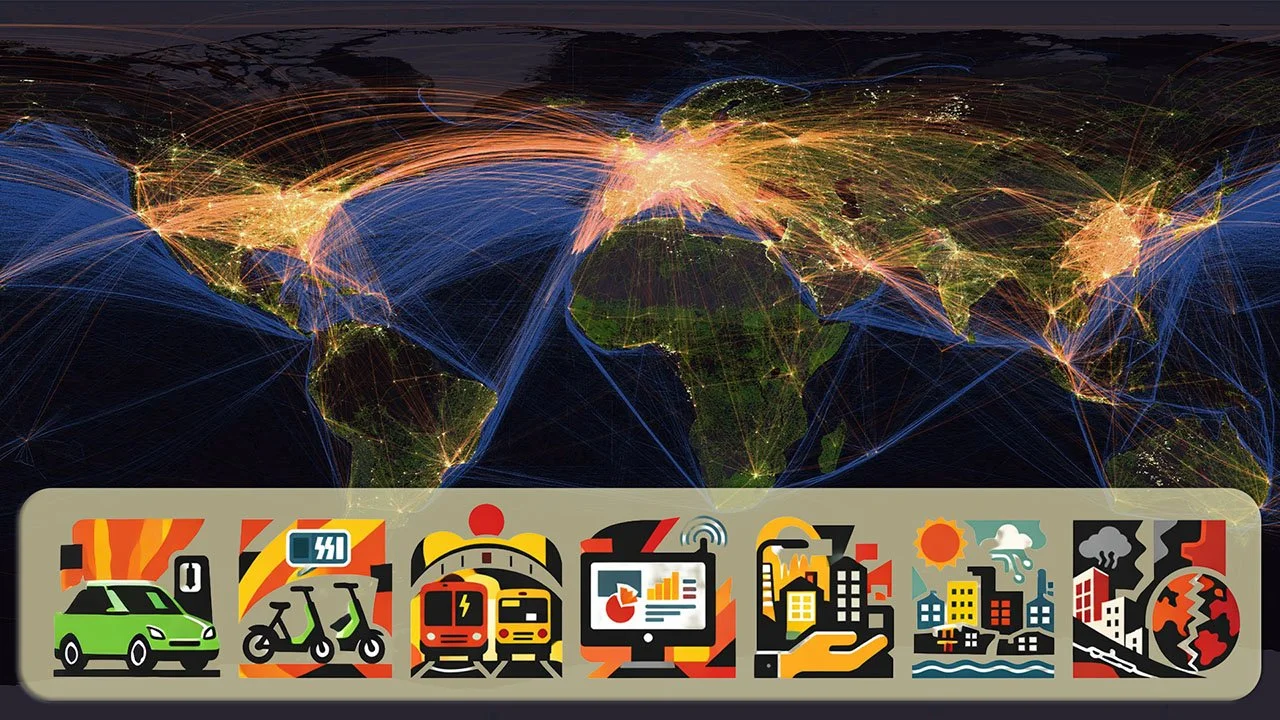
Seven defining trends point to the transition to zero-carbon mobility becoming normalized, and the centers of innovation shifting to Asia, Europe, and the Global South
Executive Summary
In 2026, global transportation and mobility systems will cross a decisive threshold. The dominant story is no longer experimentation or early adoption of sustainable mobility, but institutionalization. Electrification, automation, and multimodal integration are becoming default assumptions embedded in procurement rules, infrastructure planning, and operational models. The future of mobility is arriving not through spectacular disruption, but through coordinated, incremental decisions that steadily rewire how cities move people and goods.
This forecast synthesizes global signals to identify the structural trend lines shaping mobility in 2026 and beyond. What emerges is a picture of irreversible momentum, constrained by politics and uneven capacity, but increasingly locked in at the infrastructural level.
1. Electrification is Becoming the Default Condition
Electrification is no longer framed as an alternative pathway; it is becoming the assumed baseline. New transit projects, municipal fleets, and even logistics systems are increasingly electric by default, with combustion technologies treated as legacy exceptions.
In cities like Shenzhen, where the entire bus fleet has already been electrified, the focus in 2026 is no longer adoption but optimization, battery lifecycle management, grid integration, and operational efficiency. Similarly, Paris continues to accelerate the electrification of buses, municipal vehicles, and delivery fleets as part of its post-2024 Olympic climate commitments, embedding EVs into routine urban operations rather than pilot programs.
This shift signals that electrification has moved from a contested future into a path-dependent system reality.
2. Public Transit is Recast as Climate Infrastructure
Public transit is being reframed globally as core climate infrastructure, essential to meeting emissions targets and urban resilience goals. Electric buses, automated metros, and rail expansions are justified as tools for emissions reduction as much as for mobility services.
In India, cities such as Delhi and Bengaluru are rapidly expanding electric bus fleets, supported by national climate and air-quality mandates rather than discretionary transit funding. In Germany, continued investment in regional rail and S-Bahn electrification is explicitly tied to national decarbonization strategies, reinforcing transit as a backbone of climate policy rather than a secondary social service.
This reframing stabilizes long-term investment and shields transit from short-term political volatility.
3. Software is the New Mobility Infrastructure
By 2026, mobility performance will be increasingly governed by software, data, and AI, rather than just physical assets. Intelligent systems now determine reliability, capacity, and efficiency as much as vehicles or tracks do.
In Singapore, AI-driven traffic management and predictive maintenance systems dynamically optimize flow, reduce congestion, and lower emissions without major physical expansion. In Chennai, driverless metro operations and smart signaling systems illustrate how automation is being deployed in dense urban environments to increase capacity while reducing energy use and operational costs.
Mobility systems are evolving into adaptive cyber-physical systems, and cities without digital intelligence layers risk long-term underperformance.
4. Cities Lead While Nations Enable or Lag
A consistent global pattern is that cities and metropolitan authorities move faster than national governments. Municipal actors are piloting zero-emission zones, electrifying fleets, and deploying micromobility, often years ahead of harmonized national policy.
London continues to expand its Ultra Low Emission Zone and electrify public transport while testing new micromobility governance models. Los Angeles, despite federal uncertainty, is pushing forward with electric buses, EV charging corridors, and zero-emission freight pilots at the port level.
Cities are increasingly acting as de facto climate laboratories, while national governments play enabling or lagging roles.
5. Fragmentation and Integration Advance Together
Mobility in 2026 appears fragmented, with EVs, e-bikes, buses, rail, autonomous shuttles, and ride-hail coexisting, but this proliferation is paired with a push toward system-level integration.
In Helsinki, multimodal trip planning and unified payment systems continue to reduce private car dependency by orchestrating buses, trams, bikes, and shared vehicles as a single system. In Tokyo, dense rail networks are increasingly integrated with micromobility and last-mile services, optimizing trips based on purpose rather than mode.
The future is not modal dominance, but modal intelligence, matching energy, speed, and capacity to each journey.
6. Sustainability Is Coupled to Performance, Not Sacrifice
A defining feature of 2026 mobility narratives is the coupling of sustainability with cost, reliability, and efficiency. Climate benefits are no longer sold solely as moral imperatives, but also as operational advantages.
Electric bus deployments in Chile, particularly in Santiago, are justified by lower lifetime costs and improved air quality, not just emissions reduction. In China, large-scale EV logistics fleets are primarily adopted for fuel savings, reduced maintenance costs, and regulatory compliance. Carbon reduction follows as a structural outcome.
Decarbonization becomes durable when it is boringly pragmatic.
7. The Future Arrives Incrementally, Not Cinematically
Despite hype cycles around autonomous vehicles and urban air mobility, the dominant signal in 2026 is incremental infrastructural change. Transformation arrives through procurement rules, depot upgrades, zoning reforms, and software updates, not singular breakthroughs.
In Canada, gradual rail electrification and fleet transitions advance quietly through long-term capital planning. In Australia, city-by-city bus electrification and charging infrastructure rollouts proceed steadily, reshaping urban mobility without spectacle.
This indicates that mobility has entered its infrastructural phase: slow, political, cumulative, and increasingly irreversible.
Conclusion: Debugging the Mobility Transition
By 2026, the global mobility conversation has shifted decisively. The core question is no longer Can zero-carbon mobility work? but How do we scale it, govern it, and distribute its benefits equitably? The work ahead is less about invention and more about integration, governance, and institutional learning.
Mobility is no longer a collection of vehicles, it is a living system embedded in energy, land use, labor, and climate realities. The near future is not longer speculative. It is operational, and already under construction.
Selected Sources & Further Reading
International Energy Agency (IEA), Global EV Outlook — https://www.iea.org/reports/global-ev-outlook-2025
BloombergNEF, Electric Vehicle Outlook — https://about.bnef.com/electric-vehicle-outlook/
International Transport Forum (OECD) Annual Transport Trends — https://www.itf-oecd.org
International Association of Public Transport (UITP) — https://www.uitp.org
The Transport Politic — https://www.thetransportpolitic.com
World Resources Institute, Cities & Transport Decarbonization — https://www.wri.org
McKinsey & Company, The Future of Mobility — https://www.mckinsey.com/industries/automotive-and-assembly/our-insights